
92% of Colombians want a better education system
A large proportion of Colombians are convinced that educational opportunities are extremely unequally distributed. What can be done?
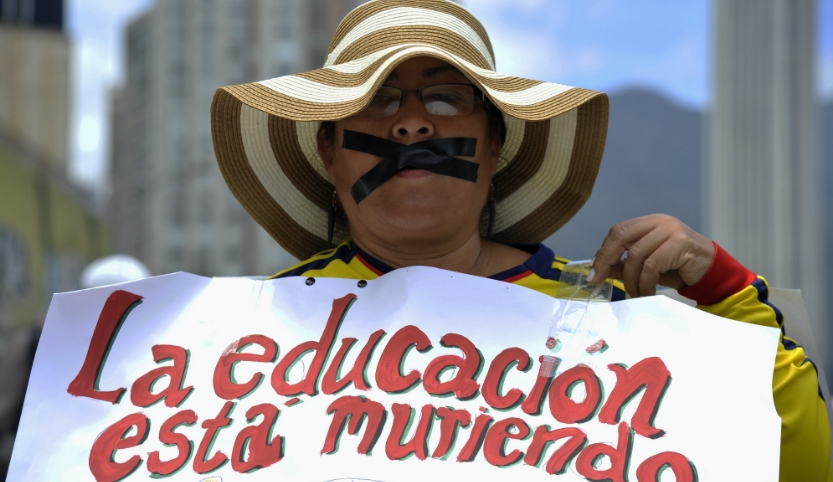

During a demonstration in Bogotá in 2015, a demonstrator holds a sign that reads "Education is dying"
Photo: Guillermo Legaria/AFP via Getty Images
Among the many sad figures in the latest report of the United Nations Development Programme (UNDP), one stands out: 92 percent of the Colombian population consider the educational opportunities in their country to be unfairly distributed. And this discontent is also evident on the streets: Only last year, trade unions and workers' associations called for a general strike.
Although the anger was actually directed against a planned tax reform, hundreds of thousands of young people joined the protests and turned them into a kind of “social explosion“. Their demand: free and quality public education. The reason for the people's discontent is easily explained. Many of them realise that the quality of public education leaves a lot to be desired in international comparison.
The poor results of the last SABER-11 exams, which are equivalent to the German Abitur, prove this. And even for the domestic labour market, the quality of education currently offered in Colombia is often not sufficient to enable real participation.